Product roadmaps @ LandTech
2022 - Calum ShepherdSome thoughts on how our product team tackled one of the most divisive topics in the product community: roadmaps.
What was the aim?
Improve our current product roadmap so everyone across the business understands what problems we intend to solve for users, in what order, and roughly when a customer might see the changes.
What problem were we solving?
Over the previous year we’d made significant changes to our roadmap format, many introduced all at once. There were positives, but feedback on both the old and new formats was, at times, conflicting.
To get to the bottom of it, we went back to basics and ran a survey to find out what people liked and disliked about the current format.
What did we learn?
People found the roadmap unclear. Specifically, we hadn’t struck the right balance between communicating:
- What we were working on
- When people might expect to see the changes
- Consistency in the level of detail provided
How did we make the changes?
We assumed that changing too much at once risked creating more confusion, not less - solving several problems simultaneously always carries the risk of introducing new ones. So we worked incrementally, starting from the existing format rather than a blank page.
Our process
- Surveyed the business to gather likes and dislikes about the current roadmap.
- Held a session with senior management to understand their needs.
- Proposed and got approval for recommended changes.
- Collaborated with product managers to refine the updates.
- Communicated the changes to the company, with guidance on how to read the new roadmap.
Roadmap qualities
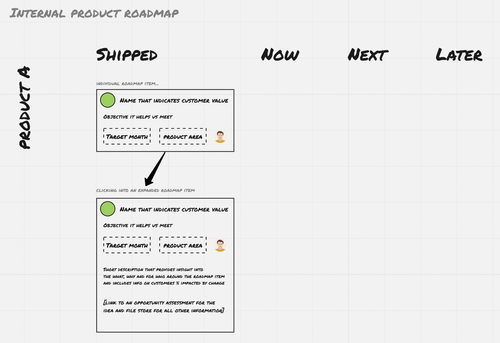
We introduced several key changes to make the roadmap clearer and more actionable:
- Organised by “Now / Next / Later” to show when work will begin.
- Clearer titles, focused on customer value rather than internal jargon.
- Alignment with objectives, for consistency with company goals.
- Consistent descriptions across every item.
- A status for each item (new idea, candidate, discovery, delivery, shipped).
- Indicative release windows (e.g. Q4, or March 2022) on each card.
- Consistent granularity between items, to improve readability.
- Links to opportunity assessments, so anyone could dig into the value case behind an idea.
Example internal roadmap
What about a public roadmap?
For now, our roadmap stays internal - the level of detail isn’t especially useful to customers.
We are, however, working on a separate public roadmap format for our community. The use case is different - gathering feedback to make sure we’re solving the right problems - so the format needs to be different too.
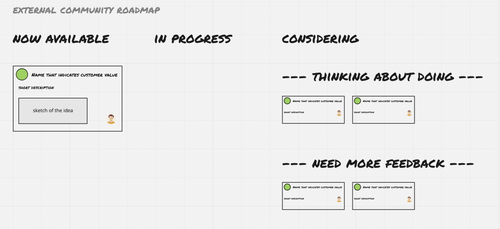
Example public roadmap
- Organised by “Now Available / In Progress / Considering,” with “Considering” split further into “Thinking About Doing” and “Need More Feedback.”
- Simplified information on each card, with early sketches for “Now Available” and “In Progress” items.
What’s next?
The focus now shifts to listening to feedback and making further improvements. We’re also preparing to roll out the public roadmap to our community soon - an exciting next step.